Uttarakhand
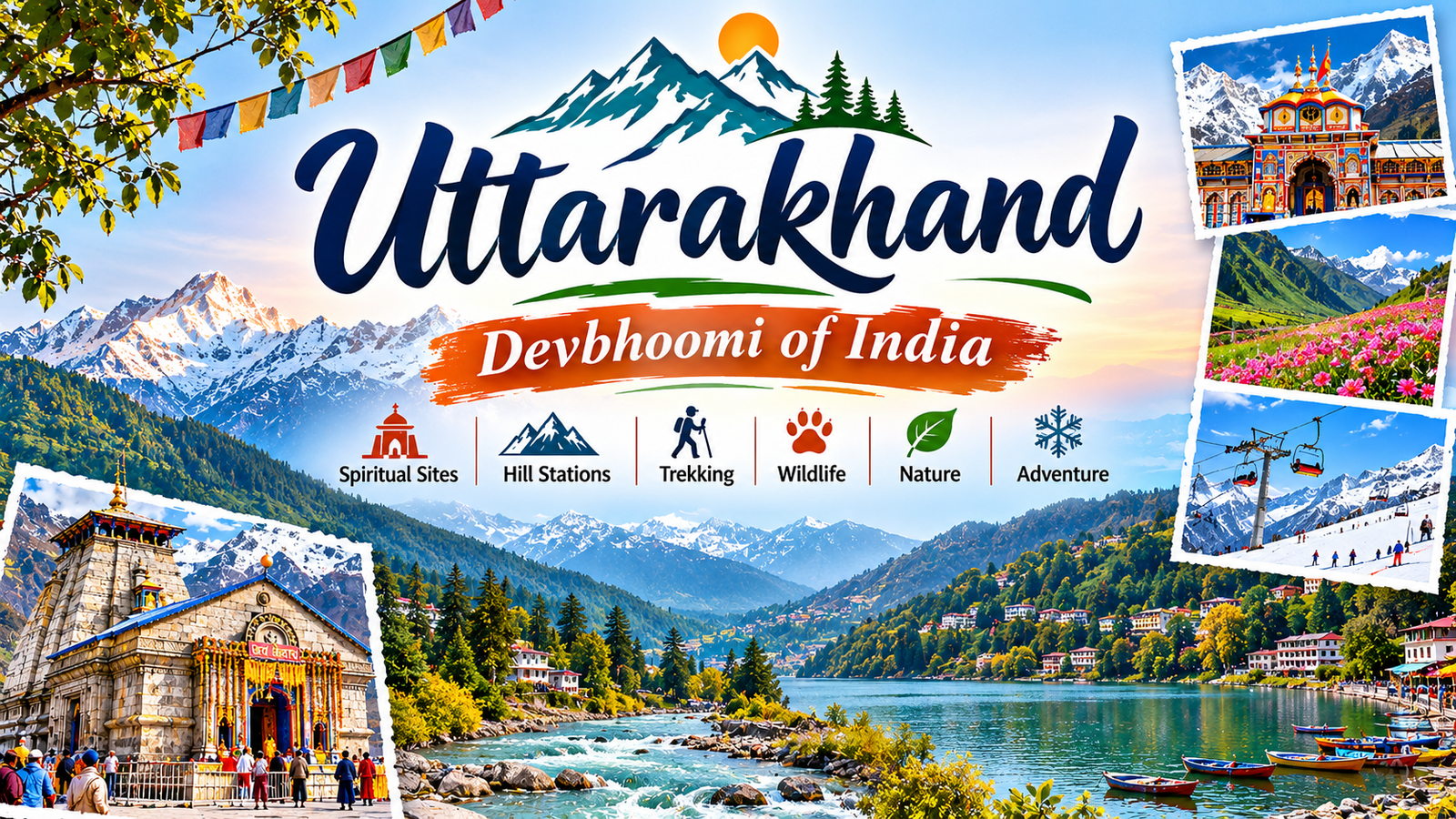
Introduction to Uttarakhand
Uttarakhand is one of the most beautiful, culturally rich, and geographically diverse states of India. Located in the northern Himalayan region, the state is popularly known as Devbhoomi, meaning the Land of Gods. It has earned this name because of its numerous ancient temples, sacred rivers, pilgrimage centres, and deep spiritual traditions.
Uttarakhand is not only famous for its religious importance but also for its snow-covered Himalayan peaks, dense forests, beautiful valleys, natural lakes, waterfalls, wildlife sanctuaries, and traditional mountain villages.
The state offers a unique combination of nature, spirituality, adventure, history, biodiversity, and cultural heritage. The holy rivers Ganga and Yamuna originate in the Uttarakhand Himalayas, making the region especially important for Indian civilization and religious traditions.
From the peaceful lakes of Nainital to the spiritual atmosphere of Kedarnath, from the forests of Jim Corbett National Park to the colourful flowers of the Valley of Flowers, Uttarakhand represents the extraordinary beauty of the Indian Himalayas.
Important facts about Uttarakhand
| Particular | Information |
|---|---|
| State formation | 9 November 2000 |
| Original name | Uttaranchal |
| Renamed | Uttarakhand in 2007 |
| Capital | Dehradun (winter); Gairsain (summer) |
| High Court | Nainital |
| Total districts | 13 |
| Region | Northern India |
| Official language | Hindi |
| Additional official language | Sanskrit |
| State animal | Alpine musk deer |
| State bird | Himalayan monal |
| State flower | Brahma Kamal |
| State tree | Burans (Rhododendron) |
| Famous identity | Devbhoomi |
History of Uttarakhand
The history of Uttarakhand is extremely ancient and closely connected with Indian mythology, religious literature, kingdoms, and Himalayan civilization.
The region has been mentioned in ancient Indian texts, including the Puranas, Mahabharata, and other religious traditions. Historically, the Himalayan region was associated with sages, saints, meditation, and spiritual learning.
Ancient history
In ancient times, different parts of present-day Uttarakhand were associated with the regions of Kedarkhand and Manaskhand.
- Kedarkhand is traditionally associated with the Garhwal region.
- Manaskhand is traditionally associated with the Kumaon region.
These regions contain many ancient temples and religious sites.
The Katyuri dynasty was an important historical power in the Kumaon region. Its influence is reflected in several historical temples and architectural remains.
Medieval history
During the medieval period, different dynasties ruled different parts of Uttarakhand.
Important historical powers included:
- Katyuri rulers in Kumaon.
- Chand dynasty in Kumaon.
- Panwar or Parmar rulers in Garhwal.
The Chand dynasty established its influence over Kumaon, while the Garhwal kingdom developed its own political and cultural identity.
British period
During the nineteenth century, the British expanded their control over the Himalayan region.
The Anglo-Nepalese War (1814–1816) resulted in the Treaty of Sugauli in 1816. After this, Kumaon and Garhwal came under British influence, although Tehri Garhwal continued as a princely state.
The British developed hill stations, roads, administrative centres, and educational institutions in the region.
Formation of Uttarakhand
The people of the Himalayan region had long demanded a separate state because of geographical, economic, cultural, and administrative differences from the plains of Uttar Pradesh.
The movement for statehood gained momentum during the 1990s.
On 9 November 2000, Uttarakhand became the 27th state of India after being separated from Uttar Pradesh.
It was initially named Uttaranchal and was officially renamed Uttarakhand in 2007.
The formation of the state represented the long struggle and aspirations of the people of the Himalayan region.
Geographical Location and Physical Features
Uttarakhand is situated in the northern part of India and forms an important section of the western Himalayan mountain system.
It shares international borders with:
- Tibet Autonomous Region of China in the north.
- Nepal in the east.
It shares state borders with:
- Himachal Pradesh in the west.
- Uttar Pradesh in the south.
The geography of Uttarakhand is highly diverse. The landscape changes from the high Himalayan mountains to middle Himalayan valleys and the fertile plains of the Terai and Bhabar regions.
Major geographical regions
1. Greater Himalayas
This region contains some of the highest mountain peaks, glaciers, and snow-covered landscapes.
Important mountain ranges and peaks include Nanda Devi, Kamet, Trishul, Chaukhamba, and Panchachuli.
2. Lesser Himalayas
This region consists of forest-covered mountains, valleys, hill stations, and traditional settlements.
Places such as Mussoorie, Almora, Ranikhet, and Pauri are associated with this mountainous landscape.
3. Shivalik Hills
The Shivalik range forms the southern Himalayan foothills. It has forests, river valleys, and lower mountain elevations.
4. Bhabar and Terai regions
These southern areas contain forests, grasslands, agricultural land, and important wildlife habitats.
The geography of Uttarakhand has a major influence on its climate, agriculture, tourism, transportation, and lifestyle.
Garhwal and Kumaon: The Two Cultural Regions
Uttarakhand is traditionally divided into two major cultural and geographical regions.
Garhwal
Garhwal is situated in the western and central parts of the state.
Its major districts are:
- Dehradun
- Haridwar
- Pauri Garhwal
- Tehri Garhwal
- Chamoli
- Rudraprayag
- Uttarkashi
Garhwal is famous for the Char Dham pilgrimage, the Ganga and Yamuna river systems, traditional folk music, and magnificent mountain landscapes.
Kumaon
Kumaon is located in the eastern part of Uttarakhand.
Its major districts are:
- Nainital
- Almora
- Pithoragarh
- Bageshwar
- Champawat
- Udham Singh Nagar
Kumaon is famous for its beautiful lakes, temples, traditional architecture, mountain villages, and folk culture.
The cultural traditions of Garhwal and Kumaon are similar in many ways but also have their own distinctive languages, food, festivals, music, and customs.
Rivers and Water Resources of Uttarakhand
Uttarakhand is one of the most important water-source regions of northern India. Several major Himalayan rivers originate or flow through the state.
These rivers provide water for drinking, irrigation, electricity generation, agriculture, and religious activities.
Major rivers
1. Ganga
The Ganga is one of India's most sacred and important rivers. Its Himalayan river system begins with the Bhagirathi, which emerges from the Gangotri Glacier region.
At Devprayag, the Bhagirathi meets the Alaknanda, and the combined river is known as the Ganga.
2. Yamuna
The Yamuna originates from the Yamunotri Glacier region in the Bandarpoonch mountain range.
It is one of the major tributaries of the Ganga and has enormous religious and economic importance.
3. Alaknanda
The Alaknanda is an important Himalayan river that flows through Chamoli and Rudraprayag districts.
It is associated with several sacred river confluences known as Panch Prayag.
4. Mandakini
The Mandakini River flows through the Kedarnath region and joins the Alaknanda at Rudraprayag.
5. Kosi and Ramganga
These rivers are important for the Kumaon region and support agriculture, local settlements, and ecosystems.
Panch Prayag of Uttarakhand
The five sacred confluences of the Alaknanda river system are:
- Vishnuprayag – Alaknanda and Dhauliganga.
- Nandaprayag – Alaknanda and Nandakini.
- Karnaprayag – Alaknanda and Pindar.
- Rudraprayag – Alaknanda and Mandakini.
- Devprayag – Alaknanda and Bhagirathi.
These five confluences are important religious and geographical landmarks.
Climate and Seasons
The climate of Uttarakhand varies greatly because of differences in altitude.
The lower areas experience relatively warm conditions, while the higher Himalayan regions remain cold and receive snowfall during winter.
Summer season: March to June
Summers are generally pleasant in the hill stations. This is a popular season for sightseeing, trekking, camping, and pilgrimage travel.
Monsoon season: July to September
The monsoon brings heavy rainfall to many parts of the state.
Forests and valleys become greener, but landslides, flash floods, and road blockages can create serious problems.
Autumn season: October to November
Autumn is known for relatively clear skies, comfortable temperatures, and excellent mountain views.
Winter season: December to February
The higher Himalayan regions experience heavy snowfall. Auli, Munsiyari, and other mountain destinations become popular for snow-related tourism.
The climate also supports different types of vegetation, wildlife, agriculture, and mountain ecosystems.
Forests and Biodiversity of Uttarakhand
Uttarakhand is one of India's ecologically important states because of its extensive forests, varied altitude, climate, and diverse natural habitats.
According to the Uttarakhand Biodiversity Board, the state covers approximately 53,483 square kilometres, and its ecosystems range from tropical forests to high-altitude alpine regions. Its biodiversity includes numerous plants, birds, mammals, insects, and medicinal herbs.
India+1
Major forest types
The forests of Uttarakhand can be divided into several categories:
- Tropical forests: Found mainly in the lower foothills and Terai regions. Sal is an important tree species.
- Subtropical pine forests: Chir pine forests are common in many middle-altitude areas.
- Temperate forests: Oak, deodar, rhododendron, and other broadleaf and coniferous trees grow in these regions.
- Subalpine forests: These occur at higher elevations and include birch and juniper.
- Alpine vegetation: Found above the tree line, consisting of grasses, shrubs, herbs, and seasonal flowering plants.
Important wildlife
- Alpine Musk Deer: A rare mountain mammal known for the musk gland of the male. It inhabits high-altitude Himalayan forests.
- Himalayan Monal: The state bird of Uttarakhand, recognised for its colourful feathers and striking appearance.
- Snow Leopard: An elusive predator found in high-altitude Himalayan ecosystems.
- Bengal Tiger: One of the most important protected wildlife species in the forests of the Terai and Himalayan foothills.
- Himalayan Black Bear: An important forest mammal that inhabits wooded mountain environments.
State symbols of Uttarakhand
| Symbol | Name |
|---|---|
| State animal | Alpine Musk Deer |
| State bird | Himalayan Monal |
| State flower | Brahma Kamal |
| State tree | Burans (Rhododendron) |
The Brahma Kamal is particularly important in Himalayan religious traditions and is associated with high-altitude regions.
National Parks and Wildlife Sanctuaries
Uttarakhand has several protected areas that help conserve endangered animals, forests, mountain ecosystems, and rare plants.
Major national parks
1. Jim Corbett National Park
Established in 1936 as Hailey National Park, it is India's oldest national park. It was renamed after Jim Corbett and became an important part of Project Tiger in 1973.
It is famous for Bengal tigers, elephants, deer, crocodiles, and rich birdlife.
2. Rajaji National Park
Located in the Shivalik landscape, Rajaji is known for elephants, leopards, deer, and diverse bird species.
3. Valley of Flowers National Park
This national park is famous for its colourful alpine flowers, natural meadows, and rare Himalayan plants.
It is part of the UNESCO World Heritage property associated with Nanda Devi and the Valley of Flowers.
4. Nanda Devi National Park
This protected mountain landscape surrounds the magnificent Nanda Devi massif and supports rare high-altitude wildlife.
5. Gangotri National Park
It protects high-altitude Himalayan landscapes, glaciers, forests, and wildlife habitats.
6. Govind Pashu Vihar National Park
This park is known for its mountain forests, alpine meadows, and Himalayan wildlife.
Conservation is particularly important in Uttarakhand because its forests protect watersheds, reduce soil erosion, support local livelihoods, and maintain the ecological balance of the Himalayan region.
Famous Tourist Destinations of Uttarakhand
Uttarakhand has destinations for almost every type of traveller, including religious pilgrims, families, photographers, trekkers, wildlife lovers, and adventure enthusiasts.
A. Famous hill stations
- Nainital is built around the beautiful Naini Lake. Its attractions include boating, Snow View Point, Naina Devi Temple, Tiffin Top, and the Mall Road.
- Mussoorie known as the Queen of Hills, Mussoorie offers Himalayan views, waterfalls, colonial architecture, and scenic walking routes.
- Auli is famous for skiing, snow-covered slopes, cable-car rides, and views of Himalayan peaks.
- Almora is famous for traditional Kumaoni culture, temples, handicrafts, mountain views, and local sweets.
- Munsiyari is a gateway to several Himalayan trekking routes and is particularly famous for the Panchachuli peaks.
B. Religious and spiritual destinations
- Haridwar: One of India's most important religious cities, famous for Har Ki Pauri, Ganga Aarti, and Kumbh Mela.
- Rishikesh: Internationally recognised for yoga, meditation, ashrams, and the Ganga riverfront.
- Badrinath: An important shrine dedicated to Lord Vishnu.
- Kedarnath: A sacred Shiva temple located in the high Himalayas.
- Gangotri: A sacred destination associated with the origin of the Ganga.
- Yamunotri: A sacred destination associated with the Yamuna River.
C. Lesser-known and peaceful destinations
Some lesser-known destinations offer a quieter experience:
- Chopta – Famous for meadows, mountain scenery, and trekking.
- Chaukori – Known for peaceful Himalayan views.
- Lansdowne – A quiet hill station surrounded by forests.
- Binsar – Famous for forest trails and panoramic mountain views.
- Khirsu – A peaceful destination in Pauri Garhwal.
- Kanatal – Known for camping and scenic mountain landscapes.
Char Dham Yatra: The Spiritual Heart of Uttarakhand
The Char Dham Yatra is one of the most important pilgrimage journeys in India. It includes four sacred destinations located in the Garhwal Himalayas.
The four sacred destinations
1. Yamunotri Dham
Yamunotri is dedicated to Goddess Yamuna. Pilgrims visit the Yamunotri Temple and nearby hot springs, including Surya Kund.
2. Gangotri Dham
Gangotri is dedicated to Goddess Ganga. The temple is located near the Bhagirathi River and is associated with the sacred story of the descent of the Ganga to Earth.
3. Kedarnath Dham
Kedarnath is dedicated to Lord Shiva and is one of the twelve Jyotirlingas. The temple is situated at a high altitude and requires a significant mountain journey.
4. Badrinath Dham
Badrinath is dedicated to Lord Vishnu and is located along the Alaknanda River. It is one of the most significant pilgrimage centres in Hinduism.
The traditional pilgrimage order is Yamunotri, Gangotri, Kedarnath, and Badrinath.
The temples generally operate seasonally because of extreme winter conditions. The opening and closing dates vary from year to year.
Culture, Languages and Traditional Lifestyle
Uttarakhand has a distinctive cultural identity shaped by Himalayan geography, agriculture, religious traditions, and community life.
Languages
The major languages and regional languages include:
- Hindi
- Garhwali
- Kumaoni
- Jaunsari
- Bhotiya languages and dialects
- Urdu and Punjabi in some communities
Garhwali is mainly spoken in Garhwal, while Kumaoni is spoken in Kumaon.
Traditional clothing
Traditional clothing varies by community and region.
Women in different parts of Uttarakhand traditionally wear garments such as ghagra, pichora, and sarees, with distinctive jewellery.
Men traditionally wear kurta-pajama, woollen garments, and regional headwear.
Folk music
Folk music plays an important role in local celebrations, weddings, agricultural activities, and religious festivals.
Some well-known traditional musical instruments include:
- Dhol
- Damau
- Ransingha
- Bhankora
- Hudka
- Mashakbeen
Folk dances
Chholiya: A traditional Kumaoni sword dance associated with wedding celebrations.
Jhora: A group folk dance in which participants dance together in a circle.
Langvir Nritya: A traditional Garhwali acrobatic dance.
Pandav Nritya: A dance-drama based on stories from the Mahabharata.
These traditions preserve the history, identity, and collective memory of mountain communities.
Famous Festivals of Uttarakhand
Festivals in Uttarakhand reflect the connection between nature, agriculture, religion, and community life.
| Festival | Importance |
|---|---|
| Harela | Celebrates greenery, agriculture, and the monsoon |
| Phool Dei | Welcomes spring and prosperity |
| Igas Bagwal | Traditional festival celebrated after Diwali |
| Ghughutiya | Kumaoni winter and Makar Sankranti festival |
| Nanda Devi Raj Jat | Important religious pilgrimage and cultural tradition |
| Ghee Sankranti | Celebrates the agricultural season |
| Bagwal | Traditional fair and ritual at Devidhura |
Nanda Devi Raj Jat Yatra
The Nanda Devi Raj Jat is one of the most significant religious and cultural traditions of Uttarakhand.
It is traditionally organised at intervals of approximately twelve years and involves a challenging pilgrimage through high-altitude mountain terrain.
The yatra is deeply connected with Goddess Nanda Devi and the cultural identity of the Garhwal and Kumaon regions.
Traditional Food of Uttarakhand
Uttarakhand's cuisine is closely connected with its climate, geography, agricultural practices, and traditional lifestyle.
Mountain communities traditionally use locally grown grains, pulses, vegetables, herbs, and dairy products. Many dishes are nutritious and provide energy for physical activities in mountainous terrain.
Famous traditional dishes
1. Kafuli
Kafuli is a traditional Garhwali dish prepared using leafy vegetables such as spinach and fenugreek. It is generally served with rice or local bread.
2. Chainsoo
Chainsoo is made from roasted black gram dal. It is known for its rich flavour and high protein content.
3. Phaanu
Phaanu is a traditional lentil preparation made by soaking and grinding pulses before cooking them into a thick dish.
4. Aloo Ke Gutke
This is a popular Kumaoni potato dish prepared with spices, mustard oil, and local herbs.
5. Jhangora Ki Kheer
Jhangora is a type of barnyard millet used to prepare a traditional sweet pudding with milk and sugar.
6. Mandua Ki Roti
Mandua, also called finger millet or ragi, is an important traditional crop. Its flour is used to prepare nutritious flatbreads.
7. Bal Mithai
Bal Mithai is a famous sweet from Almora, prepared using roasted khoya and coated with small white sugar balls.
8. Singori
Singori is a traditional Kumaoni sweet made from khoya and wrapped in a leaf, traditionally from the Malu plant.
Why is Uttarakhand food special?
- It uses locally available agricultural products.
- Traditional recipes include millets and pulses.
- Many dishes use seasonal vegetables.
- Local herbs and spices provide distinctive flavours.
- Traditional food reflects the sustainable lifestyle of mountain communities.
Agriculture and Horticulture
Agriculture is an important part of Uttarakhand's rural economy and traditional lifestyle.
However, farming in the state is challenging because of steep slopes, small landholdings, limited irrigation, and difficult transportation.
Major agricultural crops
| Crop | Importance |
|---|---|
| Wheat | Important food grain |
| Rice | Major staple crop in suitable valleys and plains |
| Maize | Grown in different mountain regions |
| Mandua | Traditional nutritious millet |
| Jhangora | Barnyard millet used in local cuisine |
| Barley | Cultivated in some higher regions |
| Pulses | Important source of protein |
| Oilseeds | Used for cooking oil |
Horticulture
Uttarakhand has favourable climatic conditions for growing various fruits and vegetables.
Major horticultural products include:
- Apples
- Plums
- Peaches
- Pears
- Apricots
- Walnuts
- Litchis
- Malta oranges
- Mangoes
Apple cultivation is particularly important in several mountain districts.
Organic and traditional farming
Traditional farming practices often involve local seeds, compost, mixed cropping, and the use of livestock manure.
Millets such as mandua and jhangora are particularly valuable because they are adapted to different mountain conditions.
Horticulture, medicinal plants, food processing, and value-added agricultural products provide opportunities to improve rural incomes.
Economy and Industries of Uttarakhand
The economy of Uttarakhand is based on several important sectors, including agriculture, tourism, manufacturing, hydropower, education, and services.
1. Tourism industry
Tourism is a major source of employment and income. Hotels, homestays, restaurants, transportation, travel agencies, guides, and adventure operators support the tourism economy.
2. Manufacturing industries
Industrial development is concentrated mainly in accessible areas such as Haridwar, Dehradun, and the industrial belt around Pantnagar and Rudrapur.
Important industries include:
- Pharmaceuticals
- Automobile manufacturing
- Food processing
- Electronics
- Packaging
- Consumer goods
3. Hydroelectric power
The Himalayan rivers provide opportunities for hydropower generation.
Hydroelectric projects contribute to electricity production, although they also require careful environmental and disaster-risk assessment.
4. Medicinal plants and herbal industries
Uttarakhand has a rich variety of medicinal and aromatic plants.
These resources support traditional knowledge, herbal products, essential oils, and related industries.
5. Education and services
Dehradun is an important educational centre. Healthcare, banking, retail, transport, and professional services also contribute to the economy.
The state's economic challenge is to create employment opportunities while protecting its fragile mountain ecosystems.
Adventure Tourism in Uttarakhand
Uttarakhand is one of India's most popular adventure tourism destinations because of its mountains, rivers, forests, and valleys.
Popular adventure activities
| Activity | Famous destination |
|---|---|
| River rafting | Rishikesh |
| Skiing | Auli |
| Trekking | Kedarkantha |
| High-altitude trekking | Roopkund region |
| Camping | Chopta and Kanatal |
| Bungee jumping | Rishikesh |
| Mountaineering | Garhwal Himalayas |
| Paragliding | Selected sites around Nainital and other hill regions |
| Wildlife safari | Jim Corbett National Park |
Famous trekking routes
Kedarkantha Trek
A popular winter trek known for snow-covered forests, campsites, and Himalayan summit views.
Valley of Flowers Trek
A beautiful seasonal trek through alpine meadows filled with colourful wildflowers.
Har Ki Dun Trek
Famous for traditional mountain villages, forests, and spectacular valley landscapes.
Kedartal Trek
A challenging high-altitude route leading to a beautiful glacial lake surrounded by Himalayan peaks.
Adventure tourism must be carried out with proper preparation, qualified guides, suitable equipment, and attention to weather conditions.
Education and Important Institutions
Uttarakhand has several important educational and research institutions.
Some prominent institutions include:
- Indian Institute of Technology Roorkee – An important institution for engineering, science, and technology.
- Forest Research Institute – Known for forestry research and education.
- Indian Military Academy – A prestigious military training institution.
- Kumaun University – A major university in the Kumaon region.
- Hemvati Nandan Bahuguna Garhwal University – A central university in Garhwal.
- All India Institute of Medical Sciences Rishikesh – An important medical education and healthcare institution.
Dehradun, Roorkee, Nainital, and other towns have developed into important centres for education and research.
Environmental Problems and Challenges
Despite its natural beauty, Uttarakhand faces several environmental and developmental challenges.
The Himalayan ecosystem is geologically young and fragile. Steep slopes, intense rainfall, seismic activity, and changing land-use patterns increase environmental risks.
1. Landslides
Landslides are a major problem in mountainous areas.
They can damage roads, houses, agricultural land, bridges, and public infrastructure.
Unplanned construction, slope cutting, heavy rainfall, and geological instability can increase vulnerability.
2. Flash floods
Heavy rainfall, glacial lake outburst floods, and sudden increases in river flow can cause severe damage.
Mountain settlements and river valleys are particularly vulnerable.
3. Forest fires
Forest fires occur frequently in some parts of Uttarakhand, particularly during dry periods.
They damage vegetation, wildlife habitats, and soil quality and can affect air quality.
4. Glacial retreat
Climate change is affecting Himalayan glaciers.
Changes in glacier size and snow patterns can influence river systems, water availability, and the risk of glacial lake-related disasters.
5. Migration from mountain villages
Many young people move from rural mountain villages to towns and cities for education, employment, and better facilities.
This can result in:
- Declining agricultural activity.
- Empty or partially abandoned villages.
- Shortages of working-age people.
- Loss of some traditional skills.
- Challenges in maintaining rural infrastructure.
6. Tourism pressure
Unplanned tourism can cause traffic congestion, waste generation, water shortages, and pressure on local ecosystems.
Possible solutions
- Promote responsible and sustainable tourism.
- Improve disaster-warning systems.
- Encourage traditional and climate-resilient agriculture.
- Protect forests and watersheds.
- Improve rural education and healthcare.
- Create local employment opportunities.
- Promote waste management and responsible construction.
- Support local handicrafts, homestays, and village tourism.
The future of Uttarakhand depends on balancing economic development with environmental protection.
Important Social and Cultural Contributions
Uttarakhand has made important contributions to India's environmental movements, literature, spirituality, sports, and national service.
Chipko Movement
The Chipko Movement was one of India's most important environmental movements.
It became particularly prominent in the 1970s in the Himalayan region of present-day Uttarakhand.
Local communities, especially women, participated in protecting forests by embracing trees to prevent them from being cut down.
Important personalities associated with the movement include:
- Chandi Prasad Bhatt
- Sunderlal Bahuguna
- Gaura Devi
The movement demonstrated the importance of community participation in forest conservation.
Military contribution
Uttarakhand has a long tradition of military service. Many people from the mountain districts have served in the Indian Armed Forces.
The Indian Military Academy in Dehradun is an important institution for officer training.
Spiritual contribution
Uttarakhand has attracted saints, philosophers, yoga practitioners, and spiritual seekers for centuries.
Rishikesh and Haridwar are internationally recognised centres of yoga, meditation, and spiritual learning.
Transportation and Connectivity
Uttarakhand is connected through roadways, railways, and air transport.
Road connectivity
Roads are the most important mode of transportation in many mountain districts.
Major routes connect Dehradun, Haridwar, Rishikesh, Nainital, Almora, Pithoragarh, and other destinations.
Railway connectivity
Important railway stations include:
- Dehradun
- Haridwar
- Rishikesh
- Kathgodam
- Tanakpur
- Ramnagar
Kathgodam is an important railway gateway for travellers visiting Nainital and several Kumaon destinations.
Air connectivity
Important airports include:
- Jolly Grant Airport near Dehradun.
- Pantnagar Airport in the Kumaon region.
Helicopter services are also used on selected pilgrimage routes, subject to weather and operational conditions.
Best Time to Visit Uttarakhand
Different seasons provide different experiences.
| Season | Months | Best for |
|---|---|---|
| Spring | March–April | Flowers and pleasant weather |
| Summer | May–June | Hill stations and sightseeing |
| Monsoon | July–September | Lush landscapes, with travel risks |
| Autumn | October–November | Clear skies and pilgrimage |
| Winter | December–February | Snowfall and skiing |
Best overall sightseeing period: April to June and October to November are generally favourable for many destinations, although the ideal time varies by altitude and activity.
For high-altitude travel, check local weather, road conditions, permits, and official advisories before departure.
A Seven-Day Travel Plan for Uttarakhand
Here is an example itinerary for someone who wants to explore a combination of spiritual places and natural beauty.
| Day | Destination | Main activities |
|---|---|---|
| 1 | Haridwar | Har Ki Pauri and Ganga Aarti |
| 2 | Rishikesh | Temples, yoga and riverfront |
| 3 | Dehradun | Robber's Cave and local sightseeing |
| 4 | Mussoorie | Mall Road and scenic viewpoints |
| 5 | Nainital | Naini Lake and boating |
| 6 | Nainital | Nearby lakes and sightseeing |
| 7 | Jim Corbett | Wildlife safari, subject to availability |
This itinerary is an example rather than a tightly scheduled route. The actual travel time depends on traffic, road conditions, and the season.
Interesting Facts About Uttarakhand
- Uttarakhand became the 27th state of India on 9 November 2000.
- The state was originally named Uttaranchal.
- It is popularly known as Devbhoomi.
- The Ganga and Yamuna river systems originate in its Himalayan region.
- Nanda Devi is India's second-highest mountain peak.
- Jim Corbett National Park was established in 1936.
- Rishikesh is internationally famous as a centre of yoga.
- The Valley of Flowers is a UNESCO World Heritage Site.
- The Chipko Movement became a landmark in India's environmental history.
- Brahma Kamal is the state flower.
- Himalayan Monal is the state bird.
- The state has two distinctive cultural regions: Garhwal and Kumaon.
- The Nanda Devi Raj Jat is traditionally held approximately every twelve years.
- Auli is one of India's recognised skiing destinations.
- Uttarakhand has a remarkable range of ecosystems, from tropical foothills to alpine landscapes.
Future Development and Opportunities in Uttarakhand
Uttarakhand has significant potential for development in several sectors.
Tourism development
The state can develop village tourism, wellness tourism, spiritual tourism, wildlife tourism, and adventure tourism.
Organic agriculture
Traditional millets, fruits, medicinal plants, and local food products can create new economic opportunities.
Renewable energy
Hydropower, solar energy, and other renewable sources can contribute to energy security when developed with proper environmental safeguards.
Rural entrepreneurship
Homestays, local handicrafts, food processing, and small businesses can create employment in mountain villages.
Education and research
The Himalayan region provides opportunities for research in climate science, geology, biodiversity, disaster management, and environmental studies.
Sustainable development
Development projects should consider the carrying capacity of mountain ecosystems, community participation, and long-term environmental protection.
Ask a question
Have a question about this article? Ask below and our team will reply.