U.S. Commercial Real Estate Investment Jumps 98% in Q3 2026
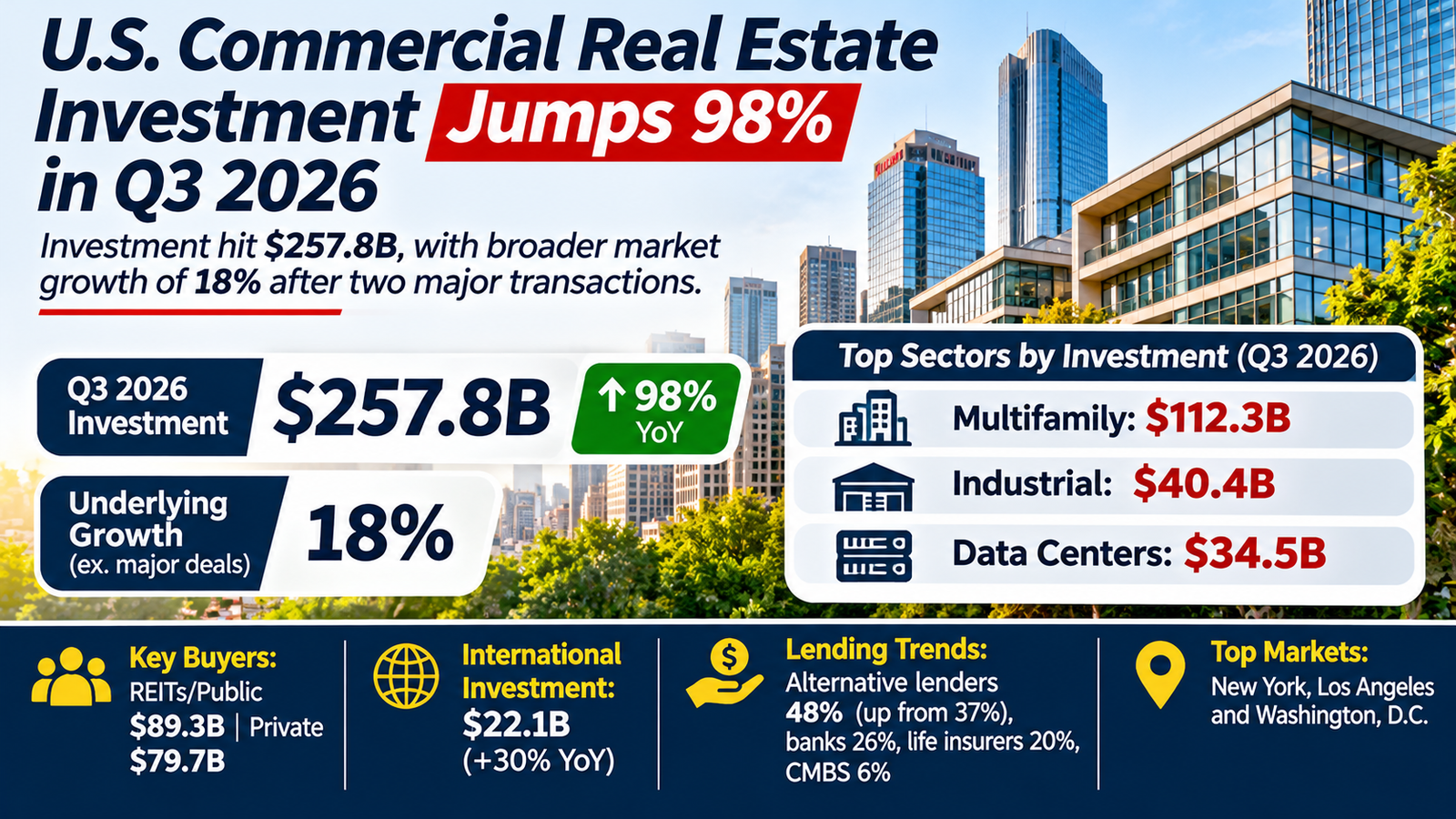
U.S. commercial real estate (CRE) investment recorded a major increase in the third quarter of 2026. According to CBRE’s Q3 Capital Markets Report, investment volume reached $257.8 billion, up 98% year over year. However, two large company-level transactions totaling $104 billion accounted for much of that increase. Excluding those deals, investment still grew by 18%, pointing to a broader but more moderate market recovery.
For the first nine months of 2026, investment reached $528.3 billion, up 59% year over year—or 24% excluding the two major transactions.
Which Property Sectors Attracted the Most Investment?
Multifamily led commercial real estate investment in Q3, followed by industrial and data center properties.
| Property sector | Q3 2026 investment |
|---|---|
| Multifamily | $112.3 billion |
| Industrial | $40.4 billion |
| Data centers | $34.5 billion |
The figures show strong investor interest in apartments, logistics facilities and digital infrastructure. These sectors have different demand drivers: rental housing serves household needs, industrial properties support distribution and supply chains, and data centers serve growing computing and digital infrastructure requirements.
Who Is Buying Commercial Properties?
REITs and publicly listed companies were the largest buyer group, accounting for $89.3 billion in investment. Private investors followed with $79.7 billion.
International capital also increased. Cross-border investment into U.S. commercial real estate reached $22.1 billion during the first nine months, up 30% year over year and approaching the $23.8 billion recorded throughout 2025.
New York, Los Angeles and Washington, D.C. were among the leading destinations for investment in Q3, highlighting the continued importance of major U.S. property markets.
Financing Conditions: More Lenders, but Borrowing Risks Remain
The lending market is changing alongside investment activity. In CBRE-originated non-agency loan closings during Q3, alternative lenders accounted for 48% of volume, up from 37% a year earlier. Banks represented 26%, down from 31%, while life insurance companies held a 20% share. Commercial mortgage-backed securities (CMBS) lending fell to 6% from 17%.
CBRE reported that commercial loan spreads narrowed to 197 basis points, while the average commercial loan-to-value ratio edged up to 59.3%. However, the average debt-service coverage ratio declined from 1.38 to 1.32, suggesting borrowers had slightly less income coverage for their debt payments. Interest-only loans also became more common, representing 82.3% of loans compared with 80.2% a year earlier.
These figures point to greater lender competition and more financing options, but they also underline the need for careful underwriting. Easier access to financing does not automatically make every property investment attractive.
What Does This Mean for Real Estate Investors?
The increase in transactions is an encouraging sign, but the headline 98% growth rate should not be mistaken for a doubling in ordinary property sales. The 18% increase after excluding the two large company-level deals provides a more useful measure of underlying momentum.
Investors should assess each opportunity based on local demand, rental income, occupancy, property condition, financing costs and realistic resale values. Multifamily, industrial and data centers attracted substantial capital, but strong sector-wide investment figures do not guarantee returns on individual properties.
What to Watch Next
Future investment activity will depend on interest rates, Treasury yields, lender appetite and property-level performance. Higher financing costs could slow transactions or put pressure on valuations, while improved borrowing conditions could encourage more buyers to return.
Ask a question
Have a question about this article? Ask below and our team will reply.