U.S. Banks Report Weaker Mortgage Demand as Housing and Commercial Property Borrowing Slows
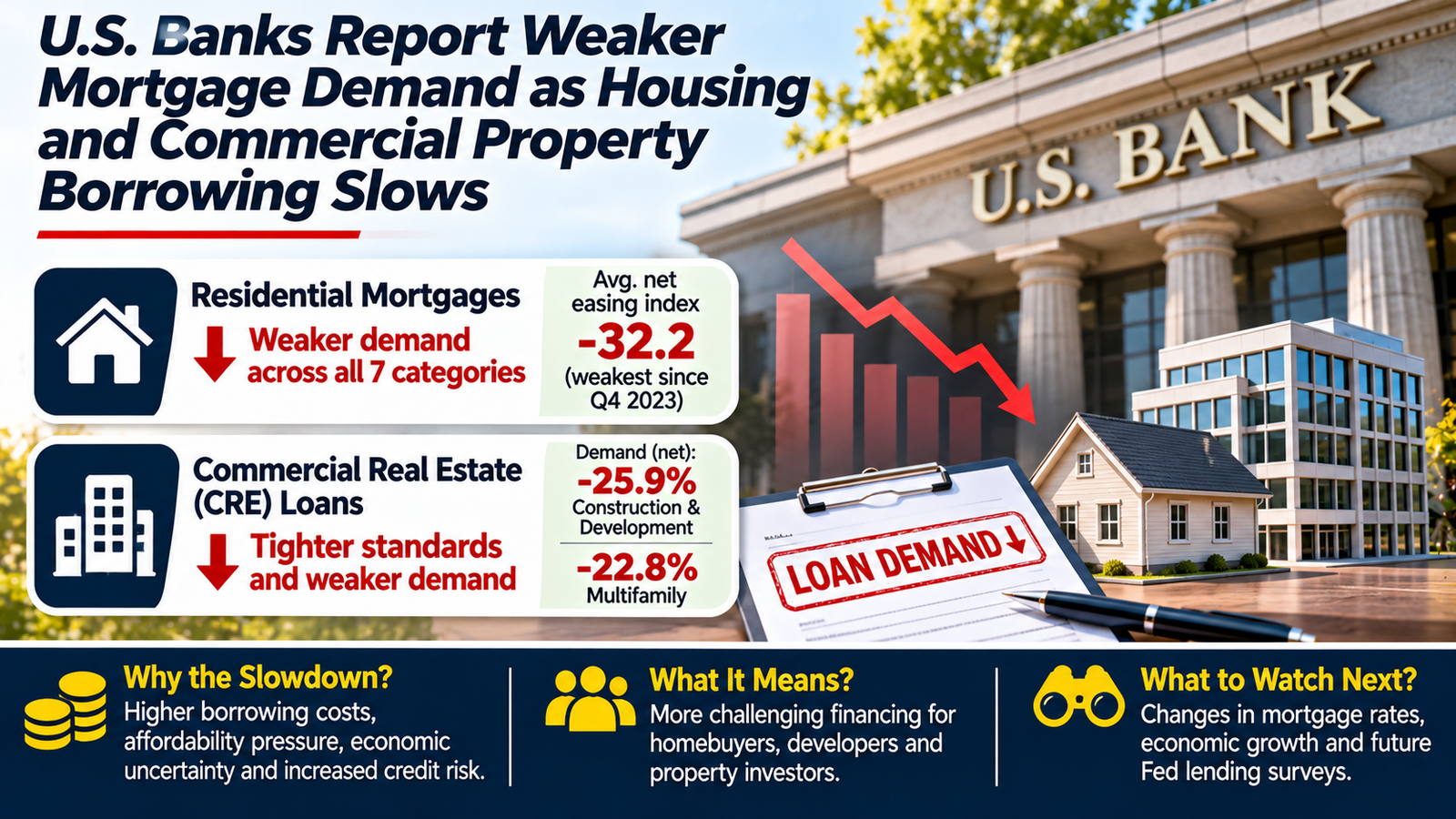
U.S. banks reported weaker demand for residential mortgages and commercial real estate (CRE) loans during the third quarter of 2026, according to the Federal Reserve’s October Senior Loan Officer Opinion Survey (SLOOS). The findings point to continued pressure on property financing, with cautious borrowers, tighter commercial lending standards and affordability challenges influencing the market.
The survey collected responses from 61 domestic banks and 18 U.S. branches and agencies of foreign banks. It measures changes in lending conditions over the previous three months.
Residential Mortgage Demand Weakens Across All Categories
Banks reported weaker demand across all seven residential mortgage categories, including government-backed, conventional, jumbo, non-qualified mortgage and subprime loans. The National Association of Home Builders (NAHB), analyzing the Federal Reserve data, reported that six of the seven categories recorded net weaker-demand readings of 30% or more.
The average net easing index across residential mortgage categories was -32.2, its weakest reading since the fourth quarter of 2023. Subprime mortgage lending conditions were particularly restrictive, recording a net easing index of -20.0, the lowest since Q1 2023.
However, banks did not tighten every mortgage category. Standards remained broadly unchanged for most residential loans, while some jumbo mortgage categories experienced easing. Subprime mortgage standards tightened, and home equity line of credit (HELOC) standards remained largely unchanged. HELOC demand was also unchanged.
Commercial Real Estate Lending Faces Additional Pressure
Commercial property financing showed a more cautious picture. Banks tightened lending standards across all three major CRE categories:
- Construction and land development: Banks reported moderately tighter standards and weaker demand.
- Multifamily: Lending standards tightened modestly, while demand weakened significantly.
- Nonfarm, nonresidential properties: Banks also reported tighter standards and weaker demand.
NAHB's analysis found net demand readings of -25.9% for construction and development loans and -22.8% for multifamily loans. Both were their weakest readings in more than two years. The net easing indices for construction and development and multifamily lending were -15.5 and -8.8, respectively.
For developers, tighter credit can mean more demanding loan conditions, additional equity requirements and greater difficulty financing new projects. For property owners, refinancing may become more challenging when lenders are cautious about valuations, cash flow and borrower risk.
Why Are Borrowers and Banks Becoming More Cautious?
Several factors help explain the slowdown:
- Borrowing costs: Higher mortgage and commercial financing costs can make property purchases, construction and refinancing less attractive.
- Affordability pressure: Homebuyers may delay purchases when monthly mortgage payments remain high relative to income.
- Economic uncertainty: Banks cited a less favorable or more uncertain economic outlook as a reason for tightening some business lending standards.
- Property investment decisions: Developers and businesses may postpone projects or reduce borrowing when expected returns do not justify financing costs.
- Credit risk: Lenders may apply greater scrutiny to borrowers, collateral values, property income and repayment capacity.
The survey reflects banks' reported lending conditions and demand; it does not mean that every borrower faces the same restrictions or that all property markets are weakening equally.
What Does This Mean for Buyers, Developers and Investors?
For homebuyers, weaker mortgage demand suggests that financing conditions and affordability remain important barriers, even though standards for many mortgage categories were broadly unchanged. Comparing lenders, improving credit profiles and assessing monthly payments carefully remain important.
For developers, tighter construction and multifamily lending could delay projects, increase financing costs or make lenders demand stronger equity contributions. For commercial property investors, refinancing risk, occupancy, rental income and debt-service coverage deserve close attention.
What to Watch Next
Future Federal Reserve surveys will help show whether weaker loan demand and tighter CRE standards persist. Changes in mortgage rates, inflation, economic growth and lender risk appetite will influence whether buyers, developers and investors return to borrowing.
Ask a question
Have a question about this article? Ask below and our team will reply.