India’s Housing Affordability Crisis: Why Owning a Home Is Becoming Harder in 2026
For millions of Indian families, owning a home remains one of life's biggest financial goals. Yet in 2026, achieving that goal is becoming increasingly difficult for buyers who depend on regular salaries and home loans.
India's residential property market is growing, but the benefits of that growth are not reaching every price segment equally. Premium housing is attracting strong demand, while sales of homes below ₹1 crore have come under pressure. At the same time, developers are launching fewer homes at lower price points.
This creates a difficult situation: people still need homes, but the properties available in many urban markets are increasingly expensive.
The issue is not simply rising property prices. Land costs, construction expenses, financing, developer margins and the location of new projects all play a part.
What do the latest housing figures reveal?
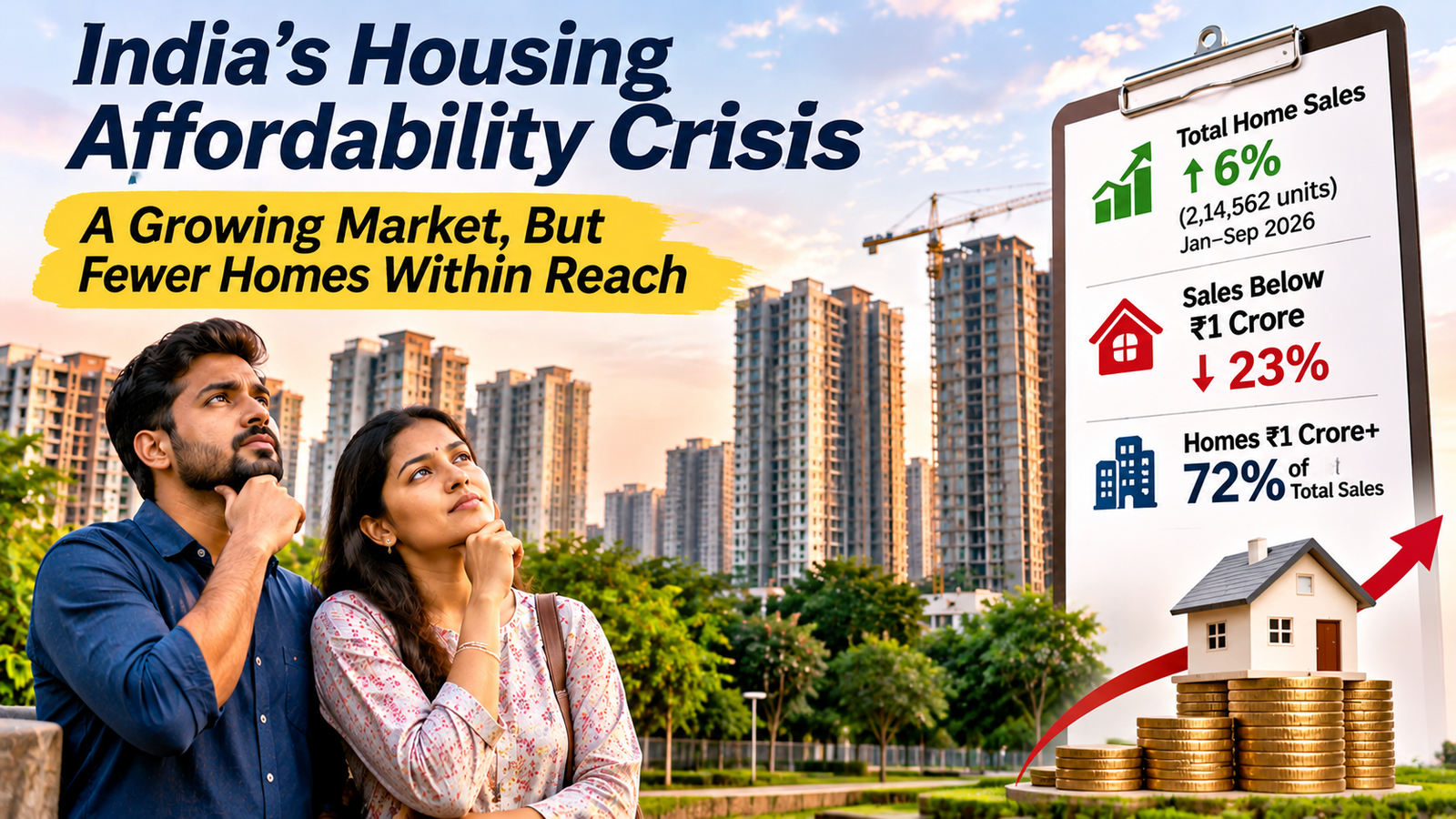
JLL data for January–September 2026 shows that housing sales across seven major Indian cities increased by 6% year-on-year to 2,14,562 units.
However, the growth was concentrated in higher-priced properties:
- Homes priced at ₹1 crore and above accounted for around 72% of total sales.
- Sales in this segment increased by 23%.
- Sales of homes below ₹1 crore declined by 23% to 59,566 units.
- The ₹1.5 crore–₹3 crore segment recorded 54% growth, reaching 79,320 units.
These numbers reveal an important shift. India's housing market is not necessarily losing demand; rather, a larger share of transactions is taking place in expensive homes.
The ₹1 crore threshold is a market reporting category, not a universal definition of affordability. Nevertheless, the decline in sales below this level highlights the pressure facing many first-time and middle-income buyers.
Why are affordable homes becoming harder to find?
One major reason is the changing supply of new housing.
According to UN-Habitat's World Cities Report 2026, affordable housing accounted for 52% of new builds in India's eight largest cities in 2018. By 2025, its share had fallen to 17%.
The report also highlighted a widening mismatch between affordable housing supply and demand. Its cited supply-to-demand ratio declined from 1.05 in 2019 to 0.36 in 2025.
Another indication comes from Anarock Capital data reported by Business Standard. Homes priced below ₹40 lakh accounted for just 10% of new launches in Q1 2026, compared with 26% in 2021. In the same quarter, homes priced above ₹1.5 crore represented 53% of launches.
These figures use different price categories and reporting periods, but they point towards the same concern: developers are bringing a smaller proportion of lower-priced homes to market.
For buyers, this means fewer options within budget. They may have to consider smaller apartments, less-connected locations or older properties instead of the new homes they originally wanted.
Why are developers choosing premium housing?
Developers operate within commercial realities. Land acquisition, construction materials, labour, approvals, financing and infrastructure all contribute to the cost of building a residential project.
In established urban locations, land can be particularly expensive. A developer building affordable apartments has limited room to absorb these costs without pushing the final selling price beyond the intended buyer's budget.
Premium projects, on the other hand, can offer greater revenue per unit and more flexibility to recover development costs. Buyers in this segment may also pay extra for larger homes, branded amenities, better specifications and established locations.
This does not mean every developer has stopped building affordable homes. However, when premium projects offer more attractive commercial returns, developers may naturally prioritise them.
The challenge is to make affordable housing financially viable without compromising construction quality, safety or access to essential services.
Rising prices are only part of the affordability problem
A home's affordability cannot be judged by its advertised price alone.
A buyer must also consider the down payment, home-loan EMI, registration charges, stamp duty, maintenance, insurance and interior expenses. For an under-construction property, delays can create additional financial pressure, particularly when the buyer is paying rent and loan instalments simultaneously.
The Reserve Bank of India's House Price Index release dated 29 May 2026 reported year-on-year growth of 4.2% in the all-India index for Q4 FY2025–26. The index covers 18 major cities and is based on transaction information received from registration authorities.
However, national averages can hide significant differences between locations. UN-Habitat's 2026 report cited price-to-income ratios of 14.3 for Mumbai and 10.1 for Delhi, compared with 5.1 for Ahmedabad and 5.8 for Kolkata in its referenced comparison.
The practical message is clear: a home that appears affordable in one city may be financially out of reach in another. Even within the same city, neighbourhood, transport access and household income can change the calculation.
What role can government housing schemes play?
Government programmes can help address parts of the affordability challenge.
Pradhan Mantri Awas Yojana–Urban 2.0 (PMAY-U 2.0) aims to support eligible urban households through different housing assistance mechanisms. Its impact will depend on effective implementation, access to finance, suitable locations and timely delivery.
The SWAMIH Fund has a different purpose: helping complete eligible stalled residential projects so that homebuyers who have already invested their savings can receive their homes.
Figures cited by Business Standard from Anarock Capital indicate that the initiative had enabled the completion of 58,596 homes, with more than 100,000 units expected in total. The article also reported the announcement of SWAMIH Fund 2.0, a ₹15,000 crore blended-finance vehicle intended to support another 100,000 stalled homes.
Such initiatives are important, but they cannot solve the entire problem. India also needs better urban planning, predictable approval processes, suitable land availability and financing for viable affordable housing projects.
What needs to change?
A more balanced housing market will require coordinated action.
- Build homes at realistic price points: Developers should study local household incomes and demand instead of focusing only on premium buyers. Efficient layouts and sensible specifications can help control costs.
- Improve land and transport planning: Affordable homes should be located near employment centres, public transport, schools and healthcare facilities. A cheaper apartment far from essential services may not be affordable in the long run.
- Improve financing: Suitable funding for viable affordable housing projects can help developers manage costs and bring more homes to market.
- Make approvals more predictable: Transparent and timely approval processes can reduce uncertainty, delays and expenses that may ultimately be passed on to buyers.
- Strengthen rental housing: Not every household is ready to purchase a property. A stable rental market can support people who are moving for work or saving for a future home purchase.
What should homebuyers do in 2026?
People planning to buy a home should begin with a realistic assessment of their finances rather than simply borrowing the maximum amount a bank offers.
Compare the total cost of ownership, including EMI, registration, maintenance and travel expenses. Check the project's RERA registration where applicable, approvals, construction progress, possession commitments and the developer's track record.
Also compare the location carefully. A lower purchase price may not be a good deal if the property is poorly connected or requires excessive daily commuting.
For investors, rental demand, resale liquidity, realistic rental yields and the quality of the project deserve as much attention as potential price appreciation.
Most importantly, avoid rushing into a purchase simply because of expectations that property prices will rise. A home should fit your financial position and long-term requirements.
What are homebuyers concerned about?
Colliers' Homebuying Sentiment Survey 2026, published in September, found that 31% of respondents identified affordability and pricing as their primary concern when considering a home purchase.
The survey also reported that 65% considered attractive pricing and flexible payment plans important to making an immediate purchase decision. More than 60% preferred ready-to-move or near-completion homes over newly launched or under-construction properties.
This preference reflects the importance of certainty in a major financial commitment. Buyers want to know when they will receive possession and whether the developer can deliver what was promised.
The figures suggest that housing demand has not disappeared. Buyers are becoming more careful about price, location, quality and delivery timelines.
Statutory FAQs
Rising land and construction costs, fewer lower-priced launches, financing challenges and developers' focus on higher-margin projects have contributed to the shortage of affordable options.
Yes. JLL data for January–September 2026 showed a 6% rise in sales across seven major cities. However, growth was concentrated in higher-priced homes, while sales below ₹1 crore declined.
Mumbai and Delhi show particularly high price-to-income pressures in the UN-Habitat 2026 report. Affordability varies significantly by locality and household income.
The scheme aims to support eligible urban households through different housing assistance mechanisms. Its effectiveness depends on implementation, eligibility and the availability of suitable homes.
There is no reliable way to predict a broad price correction across all cities. Buyers should assess their finances, loan commitments, location requirements and project quality before deciding.
No. Affordability depends on household income, savings, loan terms, location and additional ownership expenses. The ₹1 crore figure is a market reporting category, not a universal affordability definition.
Ask a question
Have a question about this article? Ask below and our team will reply.